- BY kyle
- POSTED IN Latest Blogs
- WITH 0 COMMENTS
- PERMALINK
- STANDARD POST TYPE
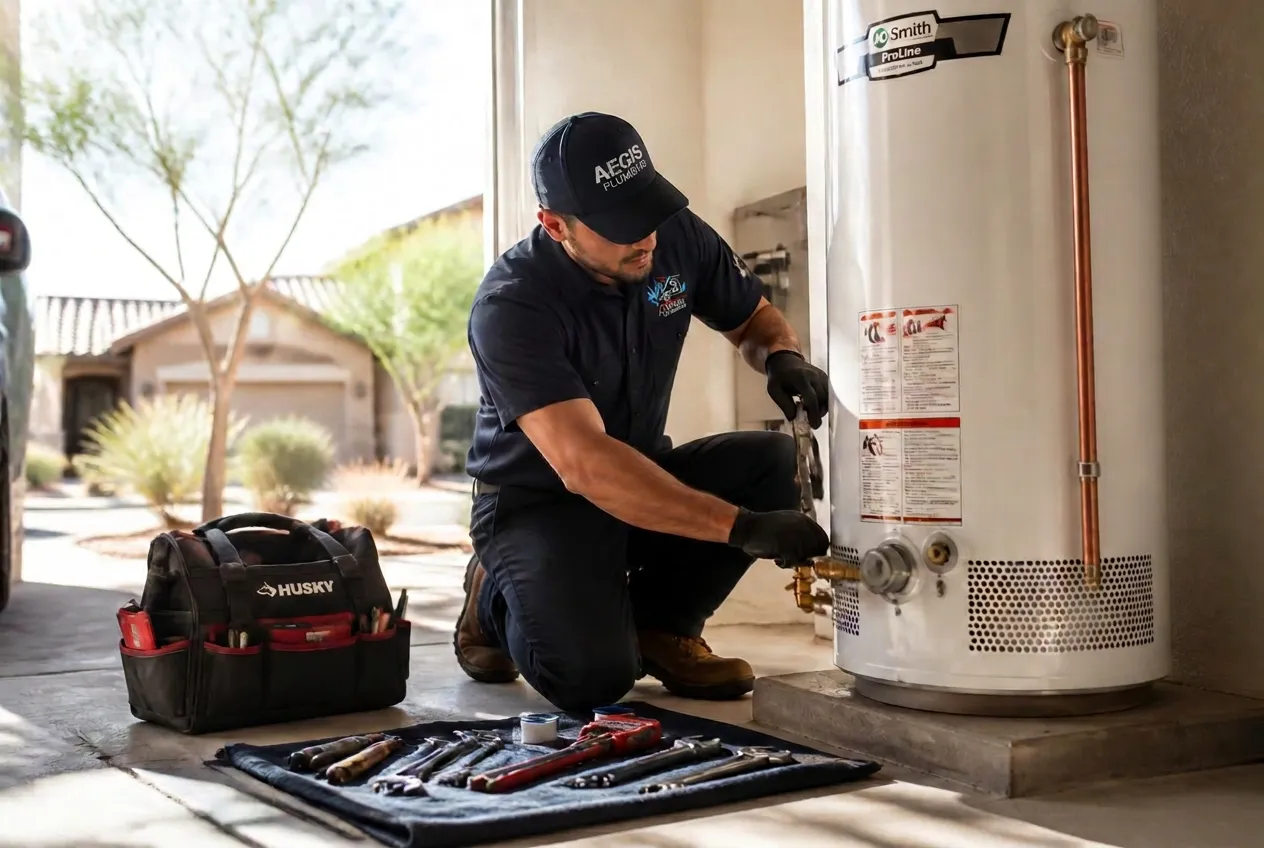
Water Heater Repair in Mesa, AZ: 7 Signs You Need Service
You walked into the garage this morning, turned the shower on, and got 90 seconds of warm water before it went cold. Or you noticed a puddle at the base of the tank. Or the whole unit is making a popping sound like popcorn in the microwave. In Mesa, AZ, a water heater problem in July isn’t just uncomfortable — it’s the kind of thing that can turn into a flooded garage, a spiked energy bill, or a full-tank failure inside a week if you ignore it.
The good news: most water heater issues we see across Mesa and the East Valley — Gilbert, Chandler, Tempe, Queen Creek — fall into a handful of predictable buckets. Some are cheap fixes. Some mean it’s time for a new unit. Here’s how to tell which is which before you call a plumber.
What to Expect in This Service Guide
- Why Mesa water heaters fail faster than the rest of the country
- Seven warning signs your water heater needs attention
- DIY checks versus when to call a plumber
- 2026 Mesa repair and replacement cost ranges
- How age factors into the repair-or-replace decision
- How to extend the life of your next water heater
Why Mesa Water Heaters Fail Faster Than the Rest of the Country
Before the symptoms, it helps to know what your water heater is up against here. Water heaters in Mesa work harder — and die younger — than almost anywhere in the country, for three reasons:
Arizona Hard Water
Maricopa County water carries some of the highest calcium and magnesium levels in the U.S. Every gallon that goes into your tank deposits mineral sediment on the bottom, right on top of the burner or heating element. That layer insulates the burner from the water, forces it to run longer and hotter, and eventually cracks the glass lining inside the tank.
Extreme Ambient Heat
Most Mesa water heaters live in the garage or an exterior closet. In July, those spaces sit at 110–125°F for weeks. The unit’s electronics, gas valve, and thermostat were designed to live in a 70° basement — not a 120° garage.
High Demand
Long summer showers, more laundry, kids in and out of the pool. Water heaters here cycle more often than heaters in cooler climates, which accelerates wear on every moving part.
Add it up and the average tank water heater in Mesa lasts 8–10 years instead of the 12–15 you’d see in Denver or Seattle. Knowing what to watch for can buy you back some of that lost life.
1. No Hot Water at All
You turn on the tap and it stays cold — or lukewarm at best. Most common causes, easiest to hardest:
- Tripped breaker or reset button (electric units — check the panel and the red button on the front of the unit first)
- Pilot light out (gas units — often means a bad thermocouple)
- Failed heating element or burner
- Failed gas control valve or thermostat
A tripped reset is free. A thermocouple is a $180–$400 job. A gas control valve is $350–$650. If the unit is over 10 years old and the failure is a major component, this is usually the moment to replace, not repair.
2. Rusty, Brown, or Cloudy Hot Water
Cold water runs clear, hot water runs orange or brown. That’s rust — from inside your tank. It means the anode rod (the sacrificial metal rod that protects the tank from corrosion) is used up and the tank itself has started to corrode.
If you catch it early enough, replacing the anode rod ($180–$350) can extend the tank’s life by years. If the rust is heavy and the tank is more than eight years old, you’re on borrowed time — the next thing to fail will be the tank wall, and that means a garage flood.
3. Popping, Rumbling, or Kettling Sounds
Sounds like popcorn, rumbling, or a slow kettle boil coming from the tank. This is the #1 Mesa-specific symptom and it’s almost always sediment buildup. Hard-water minerals have layered on the bottom of the tank; water gets trapped under the sediment, boils, and pops through — the sound you’re hearing.
A tank flush ($120–$220) usually solves it if you catch it early. If the sediment is baked on hard, flushing won’t clear it, and the burner is now working against an insulating layer of mineral scale. That means shorter tank life and 20–30% higher energy bills every month until you replace the unit.
4. Water Pooling Around the Base of the Tank
Any water on the ground under the unit is a problem. Possible sources:
- Loose or corroded inlet/outlet water connections (fixable)
- Failing T&P (temperature and pressure) relief valve (fixable, $150–$300)
- Cracked drain valve (fixable)
- Corroded tank body (not fixable — replace the unit)
The first three are real repairs. The fourth is a countdown clock. A leaking tank never gets better; the pinhole becomes a stream, then a rupture. If you’re seeing water at the base and the tank is 8+ years old, don’t wait — get a quote on a replacement.
5. Water Takes Longer to Heat Up (or Runs Out Faster)
Showers that used to be endless now run cold at the 8-minute mark. The dishwasher takes two cycles. This usually points to sediment buildup (see #3), a failing lower heating element (electric), or a partially failed dip tube inside the tank.
A single failed element on an electric unit is a $220–$450 fix. A failed dip tube is a $150–$300 fix. But if the tank is old and struggling to keep up with the same demand it used to handle easily, the unit is winding down.
6. Pilot Light Keeps Going Out (Gas Units)
You relight it, it stays lit for a day or two, then it’s out again. Common causes:
- Dirty or failing thermocouple ($180–$400)
- Bad gas control valve ($350–$650)
- Blocked burner air intake (garages full of dust, spider webs, or debris — a real Mesa issue)
- Drafty install location interfering with the pilot
Do not keep relighting a pilot that won’t stay lit. The safety cutoff exists for a reason — call a licensed plumber and get the underlying issue fixed.
7. Your Energy Bill Just Jumped for No Reason
Same household, same routine, same season last year — but the utility bill is 15–25% higher. Water heating is one of the biggest energy loads in a Mesa home, and a scaled-up tank fighting hard water can quietly cost you $30–$60 a month more than a healthy one.
This one rarely comes as a standalone symptom. It’s usually a signal that one of the other six issues is already happening in the background.
DIY vs. Call a Plumber
You Can Safely Handle These Yourself
- Resetting a tripped breaker or the red reset button on the unit
- Relighting a pilot light one time (per manufacturer instructions)
- Checking the thermostat setting (120°F is the sweet spot for Mesa)
- Clearing dust and debris from around the base and air intake
Call Aegis for Anything Involving
- Gas lines, gas valves, or a pilot that won’t stay lit
- Electrical connections past the breaker
- Anything inside the tank — anode rod, dip tube, heating elements
- Water on the ground under the unit
- Sediment flushing on a tank that hasn’t been flushed in 3+ years
- Anything that’s still wrong after you’ve done the obvious checks
Repair vs. Replace: 2026 Mesa Cost Ranges
Honest 2026 pricing for common Mesa-area water heater work. Every home is different — these are estimates, not quotes. Aegis Plumbing provides a firm, written quote before any work starts.
| Service | 2026 Mesa Cost Range |
|---|---|
| Thermostat replacement (electric) | $180 – $320 |
| Heating element replacement (electric) | $220 – $450 |
| Anode rod replacement | $180 – $350 |
| T&P (temperature/pressure) valve replacement | $150 – $300 |
| Full tank flush + inspection | $120 – $220 |
| Pilot assembly / thermocouple (gas) | $180 – $400 |
| Gas control valve replacement | $350 – $650 |
| New 40–50 gal tank water heater installed | $1,600 – $2,600 |
| New tankless water heater installed | $3,200 – $5,800 |
How Age Factors Into the Decision
The other big factor is how old the unit is. A rough rule of thumb for Mesa:
| Age of Unit | What We Usually Recommend in Mesa |
|---|---|
| Under 6 years old | Almost always repair — the unit has years left |
| 6–8 years old | Depends on the repair cost — if it’s over half the price of a new unit, replace |
| 8–10 years old | Usually replace — you’ll be back inside a year or two |
| 10+ years old | Replace, and this time consider tankless |
A quick rule: if a repair costs more than half the price of a new unit, and the tank is over eight years old, replace it. You’ll spend the same money over the next 18 months chasing the next failure.
How to Get More Life Out of Your Next Water Heater in Arizona
If you’re installing new, a few habits will get you closer to that 12–15 year lifespan Mesa homeowners rarely see:
- Flush it annually. Every spring, before summer demand hits. Removes the sediment that shortens tank life more than anything else.
- Install a water softener. This is the single biggest lever. A softener protects your water heater, your dishwasher, your washing machine, and your plumbing lines all at once.
- Add an expansion tank. Required by code on any closed system, and reduces the pressure spikes that stress the T&P valve and tank seams.
- Set the thermostat to 120°F. Hot enough for hygiene, cool enough to slow scale buildup and cut energy use.
- Replace the anode rod every 4–5 years. The cheapest possible way to extend the life of the tank itself.
A water softener plus an annual flush can genuinely add 3–5 years to a Mesa water heater’s life. That’s real money — hundreds of dollars a year in energy savings, plus a delayed $2,000+ replacement.
Why Aegis Plumbing
Aegis Plumbing is a family-owned plumbing company founded by Kyle Mabry and Justin Buckley, serving Mesa and greater Maricopa County — Gilbert, Chandler, Tempe, Queen Creek, and the East Valley. We repair and install traditional tank and tankless water heaters, service every major manufacturer, and back every job with our industry-leading 10-year labor guarantee — one of the longest in the state.
You get transparent, upfront pricing before any work starts. No surprise add-ons, no vague estimates, no upsells you don’t need. If a repair makes more sense than a replacement, we’ll tell you that. If your unit is on its last leg, we’ll say that too.
When to Call
If you’re in Mesa, Gilbert, Chandler, Tempe, or Queen Creek and you’re seeing any of the seven signs above, call Aegis Plumbing at (480) 742-9937 or request service online. We carry common water heater parts on the truck, so most repairs are one visit.
Request Water Heater ServiceFrequently Asked Questions
How much does water heater repair cost in Mesa, AZ?
Most common repairs run $150–$650 depending on the part. A thermostat is $180–$320, a heating element is $220–$450, a gas control valve is $350–$650. A full tank flush runs $120–$220. If the repair quote is more than half the price of a new unit, replacement is usually the smarter call — new tank water heaters run $1,600–$2,600 installed and new tankless units run $3,200–$5,800.
How long should a water heater last in Arizona?
Tank water heaters in Mesa typically last 8–10 years, versus 12–15 in milder climates. Hard water, garage heat, and high summer demand all shorten lifespan here. A water softener, annual flushing, and anode rod replacement every 4–5 years can push you toward the higher end of that range.
Is it worth repairing a 10-year-old water heater?
Usually not. At 10 years, you’re already past the average Mesa lifespan, the tank interior has years of corrosion, and whatever fails next is likely to be more expensive than the current repair. If you’re spending more than a few hundred dollars on a 10+ year old unit, put that money toward a replacement instead.
Why is my hot water rusty in Mesa?
Rusty hot water almost always means the anode rod inside the tank is depleted and the tank itself has started to corrode. If you catch it early, replacing the anode rod ($180–$350) can extend the tank’s life. If the rust is heavy or the tank is more than eight years old, you’re on borrowed time and should plan for a replacement.
Do I need a permit to replace a water heater in Mesa, AZ?
Yes. The City of Mesa requires a plumbing permit for any water heater installation or replacement, and gas units require an additional gas permit. Aegis Plumbing handles all permits and inspections as part of the installation — you don’t have to touch it.
Schedule Water Heater Repair in Mesa
Aegis Plumbing is a family-owned plumbing company serving Mesa, AZ and greater Maricopa County. Schedule a repair or get a quote at aegisplumbingaz.com or call (480) 742-9937.
View Water Heater Services